If you have ever tasted a coffee that made you stop mid-sip and think, what is this? — the kind of cup that feels less like a beverage and more like an event — there is a reasonable chance you were drinking Tanzanian Peaberry. The Tanzanian Peaberry flavor profile is unlike anything else in the coffee canon: bright, complex, layered with fruit and wine-like acidity, and finished with a sweetness that lingers long after the cup is empty.
Tanzanian Peaberry was one of our founding reserve selections at The Roaring Bean — the very first single-origin espresso we chose when we launched the Gatsby Reserve program. We chose it because it was the most compelling expression of what specialty coffee can be. This guide covers everything that makes the bean extraordinary: the mutation that creates it, the volcanic terroir that shapes it, the tasting notes that define it, and the brewing methods that bring out its best.
What Is Tanzanian Peaberry Coffee?
Inside a normal coffee cherry, two seeds grow side by side, pressing against each other — which is why most coffee beans have one flat side and one rounded side. But in roughly 5 to 10 percent of all coffee cherries, only one seed develops. With no twin to push against, that single seed grows into a small, dense, perfectly round bean. This is a peaberry — named for its resemblance to a garden pea. The differences go far deeper than appearance.
Why the Shape Matters
A round bean roasts differently than a flat bean. A flat-sided bean has two surface geometries — a curved back and a flat face — which absorb heat at different rates. A peaberry, being symmetrical, rolls freely in the roasting drum and absorbs heat uniformly. The result is a more consistent roast from shell to center. There is also a density factor: because all the nutrients, sugars, and aromatic precursors that would normally be divided between two seeds are concentrated into one, a peaberry is denser than a standard bean. That density means more flavor compounds per gram — and greater intensity in the cup.
A peaberry is not a defect. It is a concentration — everything the cherry intended for two seeds, delivered to one.
Peaberries cannot be cultivated on purpose — the mutation occurs naturally and unpredictably. They must be hand-sorted from the broader harvest, which adds cost and limits supply. Most commercial roasters pass. Specialty roasters seek them out precisely because of what that extra effort produces in the cup.
Tanzania's Terroir: Where the Flavor Begins
Peaberry mutations occur in every coffee-growing country — Brazil, Colombia, Kenya, Indonesia. But Tanzanian Peaberry stands apart, and the reason is terroir. Just as a Pinot Noir from Burgundy tastes fundamentally different from one grown in Oregon, a coffee cherry grown on the volcanic slopes of Kilimanjaro develops a flavor profile that cannot be replicated anywhere else.
The Volcanic Highlands
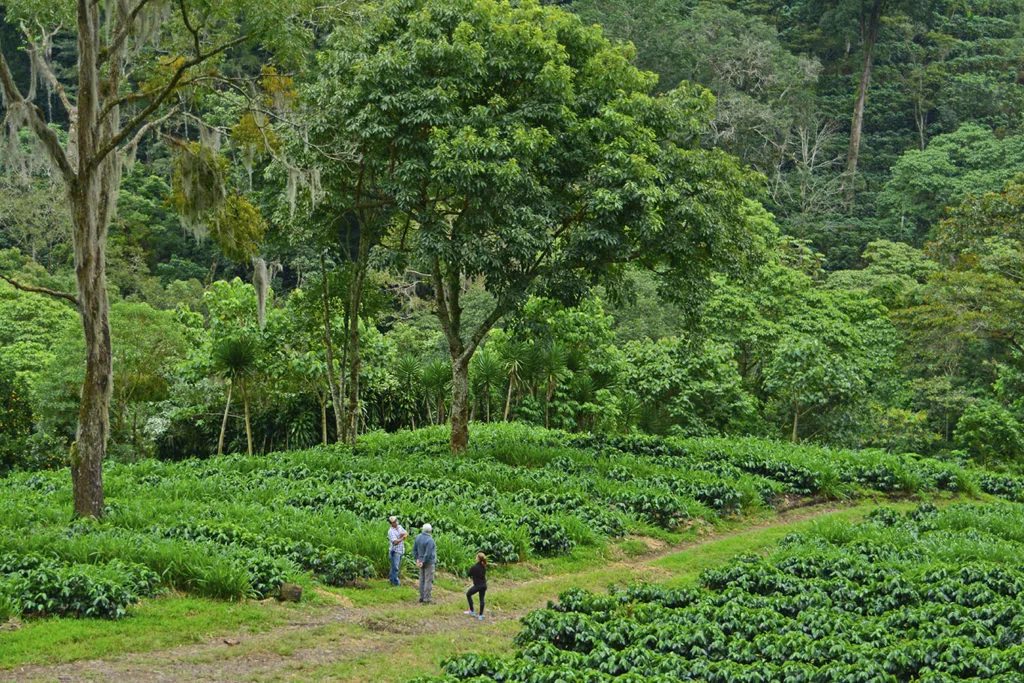
Tanzania's premier coffee regions sit at 1,400 to 2,000 meters above sea level — the slopes of Mount Kilimanjaro, the Mbeya and Rungwe highlands, and the Usambara Mountains. At these altitudes, cooler temperatures slow the cherries' maturation, allowing sugars and organic acids to develop more fully. The soil is volcanic — rich in minerals, well-draining, and deeply fertile. It imparts a distinctive mineral quality you can taste as a clean, almost crystalline brightness in the cup, much like wines from volcanic regions such as Etna or Santorini.
Processing: The Wet Method
Most Tanzanian specialty coffee is processed using the washed (wet) method — the cherry's fruit is removed mechanically, the beans are fermented in water to dissolve remaining mucilage, then washed clean and dried on raised beds. This strips away fruity fermentation flavors and reveals the bean's intrinsic character: its terroir, its genetics, its altitude signature. When you taste blackcurrant in a washed Tanzanian Peaberry, that blackcurrant is coming from the bean itself, not from processing.
The Tanzanian Peaberry Flavor Wheel
The specialty coffee industry uses a standardized flavor wheel — developed by the Specialty Coffee Association — to map flavor notes with precision. Here is where Tanzanian Peaberry lands, based on cupping notes across multiple harvests and roast profiles.
Primary Notes: Fruit Forward
- Blackcurrant — the signature note, a deep dark berry flavor that hits immediately on the first sip. Unmistakable once you know what to look for.
- Black plum — ripe, slightly tannic, and layered. Adds a wine-like dimension that sets Tanzanian Peaberry apart from citrus-driven East African coffees like Kenyan AA.
- Dark cherry — bridges the blackcurrant and plum, adding richness without heaviness.
Secondary Notes: Citrus and Floral
- Blood orange — a tart, juicy acidity that lifts the darker fruit notes. This is the brightness Tanzanian coffees are known for — not sharp, but vivid and clean.
- Grapefruit zest — present more as an aromatic than a taste, noticeable in the dry fragrance and the first bloom when hot water hits the grounds.
- Jasmine — subtle and fleeting, appearing in lighter roasts. A delicate floral layer that adds complexity without competing.
Finish Notes: Sweet and Lingering
- Bittersweet chocolate — think 72% dark chocolate. Rich, slightly bitter, deeply satisfying. This note defines the finish and is why Tanzanian Peaberry pairs so beautifully with milk.
- Brown sugar — a caramelized sweetness that emerges as the coffee cools, adding warmth to the finish.
- Black tea — a tannic quality that adds structure, the element that makes you want another sip immediately.
Body and Mouthfeel
The body is medium — not thin like some high-altitude washed coffees, but not heavy or syrupy like a Sumatran or Brazilian natural. The mouthfeel is silky, juicy, almost effervescent — a lively quality on the tongue from the bright acidity and clean processing. It is the kind of cup that makes you reach for another sip before you have consciously decided to.
If a great Kenya AA is a Sauvignon Blanc — all citrus and acidity — then Tanzanian Peaberry is a Burgundy Pinot Noir: dark fruit, structure, elegance, and a finish that stays with you.
How to Brew Tanzanian Peaberry: Method by Method
Each brewing method reveals different aspects of the Tanzanian Peaberry flavor profile. Experimenting across methods is one of the genuine pleasures of working with a bean this complex.
Pour-Over (V60, Chemex, Kalita Wave)
Pour-over is the ideal method for experiencing the full range of this bean's flavor notes. The paper filter produces an exceptionally clean cup where the bright acidity, fruit character, and floral notes shine without interference.
- Ratio: 1:16 (e.g., 20g coffee to 320g water)
- Grind: Medium-fine · Temp: 200-205°F · Brew time: 3:00-3:30
- In the cup: Bright blackcurrant and citrus up front, jasmine aromatics, a clean lingering chocolate finish. Maximum clarity.
Espresso
Tanzanian Peaberry as espresso is an experience unto itself. The pressure and concentration of espresso amplify the bean's intensity — the fruit notes become bolder, the chocolate deeper, and the body richer. A well-pulled shot produces a copper-tinged crema with an aromatic bloom that fills the room. This is the method we used when Tanzanian Peaberry was our signature Gatsby Reserve espresso at events, and it performed beautifully in milk-based drinks without losing its character.
- Dose: 18-20g in, 36-40g out (1:2 ratio)
- Grind: Fine · Temp: 200-202°F · Pull: 25-30 seconds
- In the cup: Concentrated dark fruit and chocolate, a syrupy body, a finish that lingers. In lattes and cortados, the blackcurrant cuts through milk beautifully.
French Press
French press emphasizes body and the richer, lower-register flavors. The chocolate and brown sugar notes come forward while the bright acidity softens into something rounder. If you find high-acidity coffees too lively for your palate, French press may be your preferred method.
- Ratio: 1:15 (e.g., 30g coffee to 450g water)
- Grind: Coarse · Temp: 200-205°F · Steep: 4 minutes
- In the cup: Fuller body, prominent chocolate and caramel, softened citrus. The oils add a velvety texture that complements the darker notes.
Tanzanian Peaberry also rewards experimentation with AeroPress (inverted method, 1:15 ratio, medium-fine grind, 90-second steep) and cold brew (1:8 concentrate ratio, very coarse grind, 16-20 hours in the refrigerator). Cold brew in particular transforms this bean — the low-temperature extraction leaves the sharp acidity behind and brings forward dark cherry, plum, and chocolate in a smooth, naturally sweet summer drink. The comparison to our current Gatsby Reserve Daisy Edition from Nicaragua La Bastilla is instructive: where Nicaraguan honey process emphasizes caramel sweetness and stone fruit, Tanzanian Peaberry is brighter, more structured, and more wine-like. Both are extraordinary — just different expressions of what exceptional single-origin coffee can be.
Frequently Asked Questions
What is Tanzanian Peaberry coffee?
Tanzanian Peaberry is a specialty coffee grown on Tanzania's volcanic highlands. A peaberry occurs when only one seed develops inside a coffee cherry instead of the usual two, producing a rounder, denser bean. Only 5-10% of any harvest yields peaberries. Tanzanian Peaberry is prized for its bright acidity, wine-like complexity, and tasting notes of blackcurrant, citrus, and dark chocolate.
Why is peaberry coffee special?
The single rounded bean roasts more evenly than flat-sided beans, and its concentrated mass means natural sugars and aromatics are more densely packed — producing a more intense, complex cup. The rarity (5-10% of any harvest) and labor-intensive hand-sorting make peaberries a genuine premium product in the specialty coffee world.
What does Tanzanian Peaberry taste like?
Expect bright, wine-like acidity with primary notes of blackcurrant, black plum, and dark berries. Mid-palate notes include blood orange and grapefruit zest. The finish brings bittersweet chocolate, brown sugar, and a clean lingering sweetness. The body is medium with a silky, almost juicy mouthfeel.
What is the best way to brew Tanzanian Peaberry coffee?
Pour-over highlights the bright acidity and fruit notes (1:16 ratio, 200-205°F). Espresso concentrates the intensity into a rich, complex shot (1:2 ratio, 25-30 second pull). French press emphasizes body and chocolate (1:15 ratio, 4-minute steep). Cold brew transforms it into a smooth, naturally sweet summer drink. Each method reveals different facets of the flavor profile.
A Bean Worth Knowing
Tanzanian Peaberry occupies a rare position in the coffee world: simultaneously one of the most celebrated and one of the most misunderstood single-origin coffees. Celebrated, because anyone who has tasted it well-brewed remembers the experience. Misunderstood, because the peaberry mutation and Tanzania's terroir are stories most coffee companies never bother to tell.
We tell it because we lived it. Tanzanian Peaberry was the first bean we selected for our seasonally curated reserve program — the one that set the standard for every selection that followed. Our reserve rotates with the harvest calendar, always sourcing what is exceptional right now, but the benchmark that Tanzanian Peaberry established remains: bright, complex, layered, and unforgettable.
Whether you are a home brewer exploring a new origin or an event host curious about what specialty-grade coffee tastes like at a professional espresso bar, Tanzanian Peaberry is a bean worth seeking out and savoring. If you are curious about what is currently in the Gatsby Reserve rotation, explore our current coffee selection — there is always something exceptional in the cup.